How Horse Rescues Can Better Support Their Mission Online
Make it easier for donors, adopters, and volunteers to support your rescue.
If you run a horse rescue, I could guess a few things about how your week went. You worked through lunch again. You answered a midnight text about a rescue senior showing signs of colic. You spent your own money on something the budget could not cover. The website is on the to-do list, which is somewhere below the vet bills, the hay delivery, and the volunteer who quit on Tuesday.
I'm not here to tell you to do more. You already have enough on your plate. I'm here to be honest about what helps horse rescues attract support online, and what doesn't.
A lot of marketing advice tells horse rescues to focus on their website. Add suggested donation amounts. Improve your adoption page. Rewrite your mission statement.
And yes, those things matter.
But if your entire strategy begins and ends with your website, you're likely missing the bigger issue: visibility. If new donors, adopters, volunteers, and supporters aren't finding your rescue, no amount of homepage rewriting can help if the right people never find you.
Here is what is happening, and what to do about it.
Rescue Marketing Is a Three-Layer System
The rescues that are thriving in 2026 are running on three distinct layers, and each layer does a job that the others cannot.
- Social is discovery. Instagram, TikTok, and Facebook Reels are where strangers meet you for the first time. This is where stories get told, audiences get built, and one good Reel can pull in more new donors on a weekend than your website does in a year. Social media is also used to run a "live" event, whether it be attending an auction, conducting a rescue, or the first day a horse, pony, or donkey is turned out in a field after a successful rehabilitation journey.
- Your website is conversion. When someone has decided to donate, adopt, volunteer, or buy something to support you, the website is where that decision becomes a transaction. It is the closer, not the opener.
- Email is retention. Once someone has donated, the relationship lives in their inbox. Email is how a one-time donor becomes a monthly donor, and how a monthly donor becomes someone who tells their barn friends about you.
Most struggling rescues are trying to win with the website alone or with only a social media presence. Yet, most thriving rescues are running all three layers and letting each one do what they are good at.
All Seated in a Barn (ASIAB) is the clearest current example of this in the rescue world.
- Their Instagram has over 270,000 followers.
- Their founder posts Reels almost daily, and a single strong Reel can pull thousands of comments and shares.
- Their website is clean, conversion-focused, and tightly built to capture donors and adopters who arrive ready to act.
- They sell merchandise where the proceeds fund rescue work.
- They send follow-ups, including a card with a photo of the specific horse or rescue that the donation helped, along with the rescue's name.
I know about the card and photo because I bought a hat from All Seated in a Barn and enclosed with the hat when it arrived was a card. It had a photo of Bonnie, the rescue my purchase had helped. That card cost them maybe a dollar to include with the hat. It made me a donor for life and personally touched me.
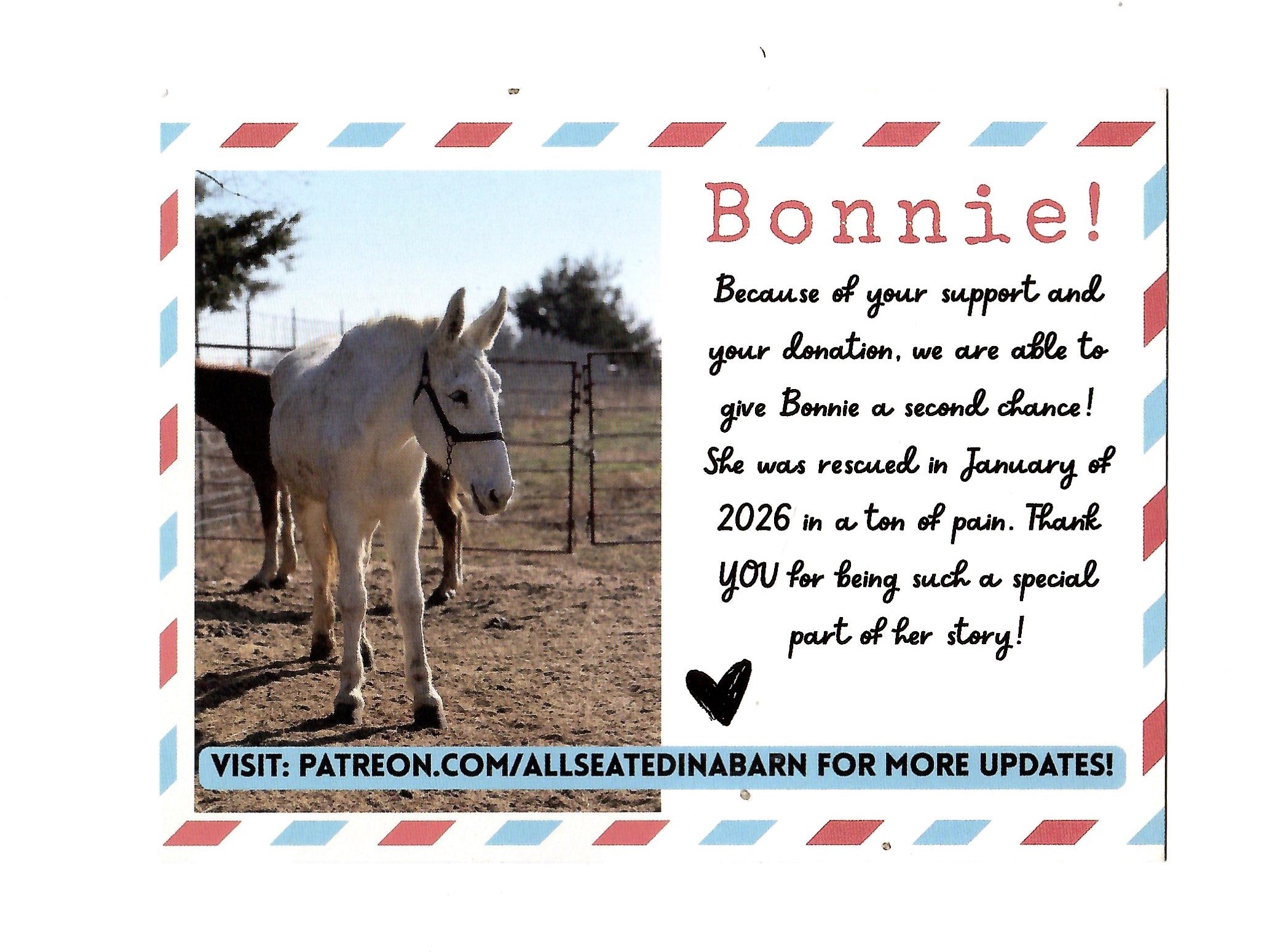
That is not a website tactic. That is the retention layer doing its job, in a coordinated system where the social layer brought me in and the website layer made it easy for me to give.
Before You Panic, Read This
I can already feel the resistance from some of you, and I want to address it directly. You are reading this and thinking, "I am 62 years old. I am not becoming a TikTok creator. I run this rescue out of my barn. I have three volunteers. The idea that I need 272,000 Instagram followers to keep my horses fed is absurd."
You are right.
Not every rescue can or should compete on the social discovery battlefield the way standout rescues do. The founders behind those standouts are, in addition to being rescuers, gifted content creators with specific personalities and skill sets that translate well to camera. Most rescue founders are not, and the answer is not to fake it.
The point is not to copy the rescues with massive followings. The point is to understand the system clearly so you can pick the layer where you can win.
- If you have a founder or volunteer who is genuinely good on camera, the social layer is the highest-leverage place to invest. Two well-told Reels a week will do more than any website redesign.
- If you do not, your strategy needs to compensate. That probably means a stronger local presence, partnerships with horse trainers and barns who can refer adopters, an email list you are using, and a website that converts the visitors you do get with much higher efficiency than average.
One more thing worth saying about the social layer, because the rescue marketing advice on the internet usually gets it wrong. The conventional wisdom says never use intake photos or hard imagery because they upset people and people stop giving.
That is half right.
Static intake imagery on a homepage tends to backfire. The visitor lands, sees a starved horse, has nowhere for the emotion to go, and leaves. They feel overwhelmed, then helpless, then guilty for feeling helpless, and the easiest way to resolve that is to close the tab.
You did not lose them because they did not care. You lost them because they cared too much and had nowhere to put it.
That same imagery in a 30-second Reel that shows the horse arriving, then the rehabilitation, then the placement, works completely differently.
The viewer is taken on a journey from despair to hope in less than a minute, and the emotion has somewhere to land. Same horse, same intake photo, different vehicle, different outcome. The Reel format gives the imagery a redemption arc. Your homepage hero image cannot do that.
The takeaway: be ruthless about hopeful framing on your homepage. Be more flexible on social, where the format can carry the harder content. Different layers, different rules.
Either way, the website still must work. It just plays a different role depending on which layer is doing the heavy lifting upstream.
What the Website Layer Actually Has to Do
Once you understand that the website is the conversion layer, the criteria for what makes a good rescue website get a lot simpler. It does not have to be a magazine. It does not have to be a brochure. It must do four jobs well.
And underneath all four jobs is one principle.
Every place where the visitor has to make a decision, hunt for information, or figure out what to do next, is a place where the visitor will quietly leave. Most rescues cannot see this from the inside, because they built the page and the choices made sense to them. But every small decision the visitor faces is an excuse to bounce, and the rescues that win are the ones who relentlessly remove those excuses. So let's get into the four jobs of your website.
1. Make the donation a real transaction, not a generic checkout.
The donation button on most rescue sites sends people to a PayPal page with an empty amount field. That sounds harmless but think about what is happening. The visitor wanted to help. Now they have to invent a number. Is $20 too cheap? Is $100 too much? What is the right amount?
The decision starts to feel heavier than the donation itself, and most people resolve that hesitation by closing the tab. You did not lose them because they changed their mind. You lost them because you handed them homework at the exact moment they were ready to give.
A donate flow that works removes that decision. Suggested amounts tied to specific outcomes do the work for the donor.
"$25 covers a week of senior feed for Junebug."
"$150 covers a farrier visit for one horse."
The visitor stops calculating and starts choosing. It also includes a prominent monthly giving option, because recurring donors are worth far more over time than one-time donors and they smooth out the cash flow that makes rescue operations so brutal.
The most important thing it includes, the thing almost no rescue is doing, is a follow-up that turns the donation into a moment of connection.
The friction here is different from the others. It is not stopping someone from giving. It is preventing the next thing they would have done. The donor gives, gets a PayPal receipt, and the relationship ends there. They never become a recurring donor. They never tell their barn friends. They never come back to buy merch. Not because they did not care, but because nothing reminded them they were part of something.
All Seated in a Barn sends physical cards with a photo of the specific horse or rescue the donor helped. You can send an email with a photo. You can send a video from the barn.
The mechanism matters less than the principle: the moment after the donation is the most generous moment of the entire relationship, and most rescues let it disappear into a confirmation screen.
2. Run an adoption pipeline that moves horses.
Most adoption pages read like classified ads: name, age, breed, height, maybe a fee, followed by a generic contact form.
But what happens when a qualified adopter finds your website at 9 p.m. and is ready to apply?
For many rescues, the answer is: download a PDF application, print it, fill it out by hand, scan it, and email it back. That process creates unnecessary friction and often costs you serious adopters who were ready to take the next step.
A stronger adoption pipeline makes the process simple and transparent. It clearly explains what adoption looks like, including timelines, fees, home checks, and expectations. It offers a mobile-friendly application that can be completed online in minutes. And it helps pre-qualify applicants upfront with questions about riding experience, boarding plans, and intended use.
Just as importantly, horse descriptions should be honest and specific. "Companion only, requires daily medication, not suited for beginner owners" helps the right adopters self-identify. "Sweet horse looking for a forever home" tells them almost nothing.
The easier you make it for qualified adopters to move forward, and the clearer you are about fit, the better outcomes you create for both people and horses.
3. Recruit volunteers like you mean it.
"We always need volunteers" is not recruiting copy. When the page is that vague, you are asking the volunteer to figure out what skills you might need, whether they have those skills, what your schedule looks like, and whether their life can accommodate it. That is three questions you should have answered for them, and most well-intentioned visitors will not push past those questions on their own.
They close the tab and the rescue assumes there are not enough volunteers in the area. But there are; they just bounced off your page.
A volunteer page that fills shifts looks more like a job board. Specific roles, specific time commitments, specific outcomes.
- Saturday morning barn crew, 7 to 10 AM, mucking and feeding, training provided.
- Adoption event photographer, one Saturday a month, three hours, must have a decent camera.
- Grant writing volunteer, remote, five hours a month, previous experience preferred.
A vague ask gets vague responses (or no responses). A specific ask gets specific people, and specific people stick.
4. Sell merchandise like a small business, not a nonprofit.
This is a move that the highest-performing rescues have nailed and most rescues are leaving on the table. A hat with your logo is not just a fundraiser. It is a wearable referral. Every person who buys one is a small piece of marketing infrastructure for you, walking around their barn or their grocery store telling people about your rescue without you doing anything.
The catch is that the merchandise has to be good quality. Designs that look like they came off a 2012 fundraiser. Sad-eye horse photos on hoodies. A logo that nobody under 50 would wear. None of that works.
The merchandise must be something the buyer would have bought even if it were not for charity, with the rescue connection as the reason they chose yours over a similar product. Get that right, and merchandise becomes the most efficient new-donor acquisition channel you have.
Where to Start
Pick the marketing layer that is most "broken" and fix that one first.
- If you have a tiny social following and a website that nobody is visiting, the discovery layer is your bottleneck. The website fixes will not matter until people are finding you. Find someone in your volunteer base who is good on camera, give them permission to tell stories, and commit to two posts a week for ninety days.
- If you have decent social traffic and your donations are not converting, the website is your bottleneck. Fix the donate flow, the adoption pipeline, and the volunteer page in that order. Rewrite the homepage hero image and headline so they convert the traffic you are already getting.
- If you have donors but they are not coming back, the retention layer is your bottleneck. Start an email list. Send something monthly with a photo and a story. Send a personal note after every donation, even if it is just an email with a photo of the horse the donation helped.
You must know what your bottleneck is and stop trying to fix the wrong thing.
The Bigger Point
Rescue work is hard, and the people who do it are some of the most committed, exhausted, generous people in the equine industry.
Nothing in this post is meant to suggest you are not working hard enough. But you may be working too hard on a marketing strategy that is not pulling its weight.
A rescue marketing system in 2026 is not just a brochure website. It's a coordinated system where each channel does the job it's best at.
When it's working well:
- Social media introduces new people to your mission
- Your website turns visitors into donors, adopters, and volunteers
- Email keeps supporters engaged long after their first interaction
When it's built around outdated habits, effort leaks at every stage, and you're left wondering why growth feels so difficult.
You did not get into rescue work to become a marketing strategist. But your horses need the marketing system to work, because marketing is what brings the resources to help your mission succeed.
Want the free Website Audit Checklist? Fifteen specific things every small business website should be doing, with examples for equine, pet, and veterinary businesses. Available on the homepage.